Visiting EVI LICHTUNGEN Hildesheim 2026
REVIEW by Khadouja Tamzini
PUBLSIHED 3 MAR 2026
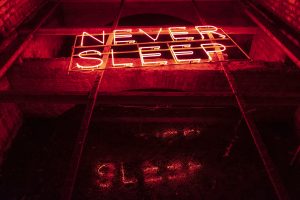
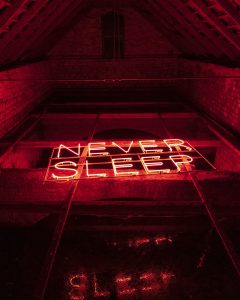
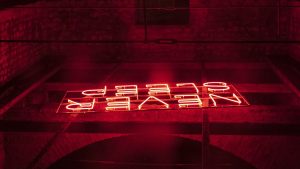
Dear Never Sleep,
At first glance, your minimalism appears aligned with the tradition of conceptual text-based art, recalling practices that tried to disrupt visual regimes and foreground language as a sculptural and political material. Yet in the contemporary city, your phrase struggles to distinguish itself from advertising slogans, motivational quotes, and algorithmic mantras. The city is already full of commands: Work more, be productive, stay connected, optimize yourself. In this context, your glowing injunction risks becoming another layer in the architecture of exhaustion rather than a rupture within it.
Your red-neon glow is not an image, not a story, not a site-specific gesture in the traditional sense. It is a command, bare and authoritarian in its simplicity. Your ambiguity is often cited as your strength. Are you ironic? Are you critical? The uncertainty is seductive, but also politically precarious. In a world where ambiguity is frequently co-opted by power structures to avoid accountability, your refusal to declare a position feels less like resistance and more like evasion. If everything can be read as a critique, everything can also be absorbed as decoration.
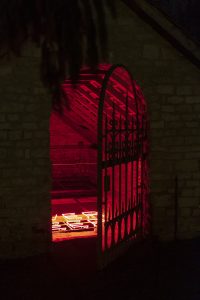
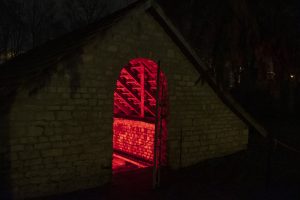
Placed within EVI LICHTUNGEN, a festival that negotiates between public space, audience, and artistic intervention, you occupy a space that is already charged with histories of extraction, circulation, and movement. Your site, the small historic home of the “Sültequelle”, with its associations to water, industry, and urban development, is not a neutral backdrop. Yet your engagement with this context remains thin. The phrase could be placed anywhere, an airport, a shopping mall, corporate lobby, and would read almost identically. The specificity of place dissolves into the generic temporality of 24/7 capitalism.
You speak to insomnia, vigilance, and the demand for perpetual activity, but you do so from a distance that feels strangely detached from the bodies that must endure these conditions. In an era where rest has become a political act and sleep a site of struggle, your work hovers between critique and command, never fully committing to either. The audience is left suspended. Are they meant to resist you, laugh at you, internalize you, or simply scroll past with their eyes?
There is also a troubling comfort in your form. Placed within a festival context, the work risks dissolving into aestheticized urban decoration; another luminous text competing with signage, branding, and attention economies. Instead of rupturing the city’s rhythms, it seems to harmonize with them. Neon text is now fully integrated into the aesthetic economy of contemporary art and urban branding. It circulates effortlessly across Instagram, biennials, and luxury retail. Your glowing letters risk aestheticizing exhaustion, transforming systemic violence into a consumable image. The work becomes photogenic, shareable, and ultimately harmless, absorbed into the visual economy it might wish to question.
And yet, I cannot fully dismiss you. Your discomfort is precisely what makes you difficult to curate. You expose the fragility of critical gestures within institutional and festival frameworks. You reveal how easily critique can become spectacle, how language can oscillate between poetry and propaganda. In this sense, you are less a statement than a symptom; a sign of a culture that no longer knows how to rest, disconnect, or imagine temporalities beyond productivity.
I do not find you beautiful. I do not find you generous. I am not seduced by you. I am unsettled by it, but at the same time, I find you revealing. You reveal how festivals frame public space while often neutralizing its political potential, and you reveal how language, once a radical tool, is now deeply entangled with the logics of power it seeks to dismantle.
So, I look at you not as a seductive artwork, but as a problematic presence, a critical friction in the landscape. I perceive you as unsettling, irritating, and forcing me to confront my own exhaustion as a curator within this system.
Sincerely,
A tired curator who insists on sleeping