Interview with RaumZeitPiraten
while preparing for EVI LICHTUNGEN in Hildesheim 22–25 JAN 2026.
INTERVIEW BY by Proidisvet Kseniia
PUBLISHED 12 JAN 2026
RaumZeitPiraten (Tobias Daemgen, Jan Ehlen, Moritz Ellerich) is a three-person artist collective working in media art and installation, with a strong focus on media archaeology and experimental machines. Their practice combines custom-built electronics, light, sound, and mechanical elements to explore perception, human–machine relations, and the agency of technological systems. Through works such as GIFmeister, AUTO/RE-VERSE, and KommunikationsProthesen, they create autonomous, post-digital installations that invite viewers to experience media as an active, sensory process rather than a passive tool.
RaumZeitPiraten have been connected to EVI LICHTUNGEN since the early editions of the festival. They participated in EVI LICHTUNGEN 2015, curated by Bettina Pelz and Klaus Wilhelm, presenting the work ExplodedCinema (Kressmann) in the city’s public space. In this installation, the collective created a cinematographic situation in which the interaction between a light installation and passers-by was projected onto a canvas in the urban environment. Through this projection, everyday movement and incidental participation became part of a cinematic event, unfolding in real time and without a fixed narrative.
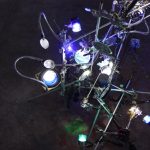
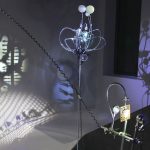
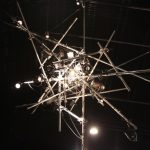
In the EVI LICHTUNGEN 2026 edition, the artist collective RaumZeitPiraten will present a site-specific installation from their ongoing series Drafts for Zero Gravity, extending their long engagement with media art, installation, and sensory experience. In this work, audiences are invited into a surreal spatial environment where light, sound, and technology merge to reshape perception and challenge familiar physical orders. Please meet RaumZeitPiraten, who responded to the questions conducted by Kseniia Proidisvet.
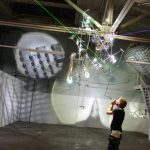
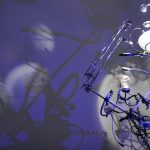
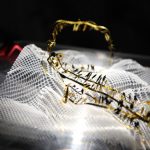
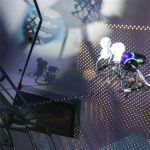
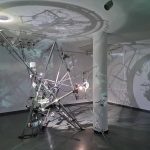
// You work as a team of three people, which seems to be an artistic decision in itself, especially considering the stylized photography with three faces on your website. How does working as a trio influence your artistic process when you develop your works?
Yes, working as a group is a decision and has a great impact on what we do. Creating artworks is a constant process, what we once had to discuss in a closed loop with ourselves in a single head became a wild and open journey between three heads with different perspectives and approaches.
// Your work often seems to evolve around an engineering solution combined with artistic and emotional expression, forming what could be described as an alternative media-archaeological realm. How do you come up with ideas for your inventions?
Looking at contemporary technologies makes us suspicious. We have a lot of questions about how technology is designed and produced and how it is used, in general in everyday live and in special in the artworld. It often feels like we, our behaviour and our outputs are programmed by technologies but maybe it should be the other way round or even better, like co-creative practice of humans and technology with no specific direction of command?
// You describe your machines as having agency—for example, through sensors and light they attempt to make contact with the viewer. Can we describe them as sensitive or even feeling machines, considering their sensor-based responsiveness? If so, what do you think your machines. such as Drafts for Zero Gravity, “feel”?
Our machines do not feel anything but even when we started 20 years ago we felt a misunderstanding between two realms that nowadays get more attention through new misunderstandings about AI. Technology can be used as a mirror, the old tradition of looking at the human body and the brain as a machine sounds cold but still works as valuable metaphor. When we look at weird machines that react to our behaviour but seem to do something on their own with this data with no direct connection to a “useful production” human brains may start to produce question marks. This is a line of production we like.
// You refer to some of your installations as “self-sufficient media sculptures.” What does it mean for a machine to be self-sufficient, and why might a machine need to be self-sufficient?
Self-sufficiency in its diverse possible interpretations seems a quite desirable state. Not only for machines.
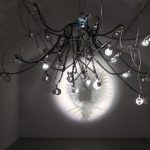
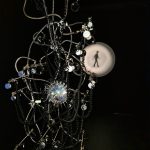
// Some of your works, such as GIFmeister (2017), present very unique forms of machinery that may not be immediately legible to the viewer. What kinds of feelings, perceptions, or thoughts do you aim to evoke in the viewer when designing your pieces, if you aim to evoke any at all?
The GIFmeister is one of these machines, that “could have been” if media history would have unfolded differently. Our works are about alternative realities and the insight that the reality we embed ourselves is just one of infinite others. The GIFmeister would have been possible to build in the times and ideas of Edweard Muybridge but nobody did, so we invented this missing piece in the history of the moving image.
// Considering that you work as a collective and that your works often display a degree of autonomy, what is your view on the concept of artistic authorship?
Maybe we can not participate in this discussion as we do not produce things that can be produced by any-one or any-thing. We do like to invent stuff that withdraw from common sense and common lines of production. In the future machines will do that for us anyways so we decided to use our time for things that can not be done by machines. If other humans work as we do i guess its time for some hugs.
// I find your works highly referential to modern philosophy. Concepts such as agency, subject–object relations, the rhizome, territorialization, the cyborg, the body without organs, and even accelerationism may come to mind when experiencing your work. What are your philosophical or theoretical sources of inspiration?
We are quite bad in name-dropping or maybe we decided to be bad with this academic game. We do like philosophy but more as a practical, living thing that endlessly evolves in us and with us. You mention the figure of the “rhizome”, this is actually a fine map drawn from Deleuze and Guattari to start with and i strongly recommend to go down this route for a while.
// You often work closely with the environment, adapting your installations to different exhibition conditions. What do you consider the ideal environment for your works to be shown and perceived?
Our work is about imperfection and adaption so the ideal environment is always the one that is at hand.
// What was your experience preparing for EVI LICHTUNGEN?
Growing again…
Very mysterious! Thank you very much, I am looking forward to experiencing your work in person!