Interview with Corrie Francis Parks, Daniel Nuderscher, Thom Parks and Sandro Nicolussi
INTERVIEW BY Johanna Baumgart
PUBLISHED 13 JAN 2026
Over the past two years, SKRFF has been presented and recognized at numerous international festivals and competitions like WATERLIGHTFESTIVAL 2024 in Brixen (it), ANIMAFESTA 2025 Zagreb (cr) or BLIND WALLS FESTIVAL 2025 in Breda (nl). For EVILICHTUNGEN 2026, a new version of SKRFF has been created, specifically adapted to the underpass space at Trogstrecke am Klingeltunnel, Von-Wintheim-Straße.
// Can you briefly introduce you and your artwork for EVILICHTUNGEN?
Corrie: I am an animator and filmmaker from Baltimore, USA. I like to find new ways to bring unusual objects and materials to life so animating a graffiti wall was right up my alley!
Daniel: I am a visual artist living in Austria, working with different materials and techniques. One of my main interests is experimenting with materials and tools to find new approaches or hidden sides of things.
Thom: I am a photographer and philosopher living between Baltimore Maryland and Aspen Colorado, USA. My photography and philosophy both aim to explore layers and experience. I have worked with Corrie on technical aspects of many of her short films over the years.
Sandro: I am a musician from Vienna and composed the music and sound design for SKRFF. In my work I focus on found sounds and heavy manipulation of Field Recordings and everyday noises, so I am happy to take some time to go sound hunting around Evilichtungen.
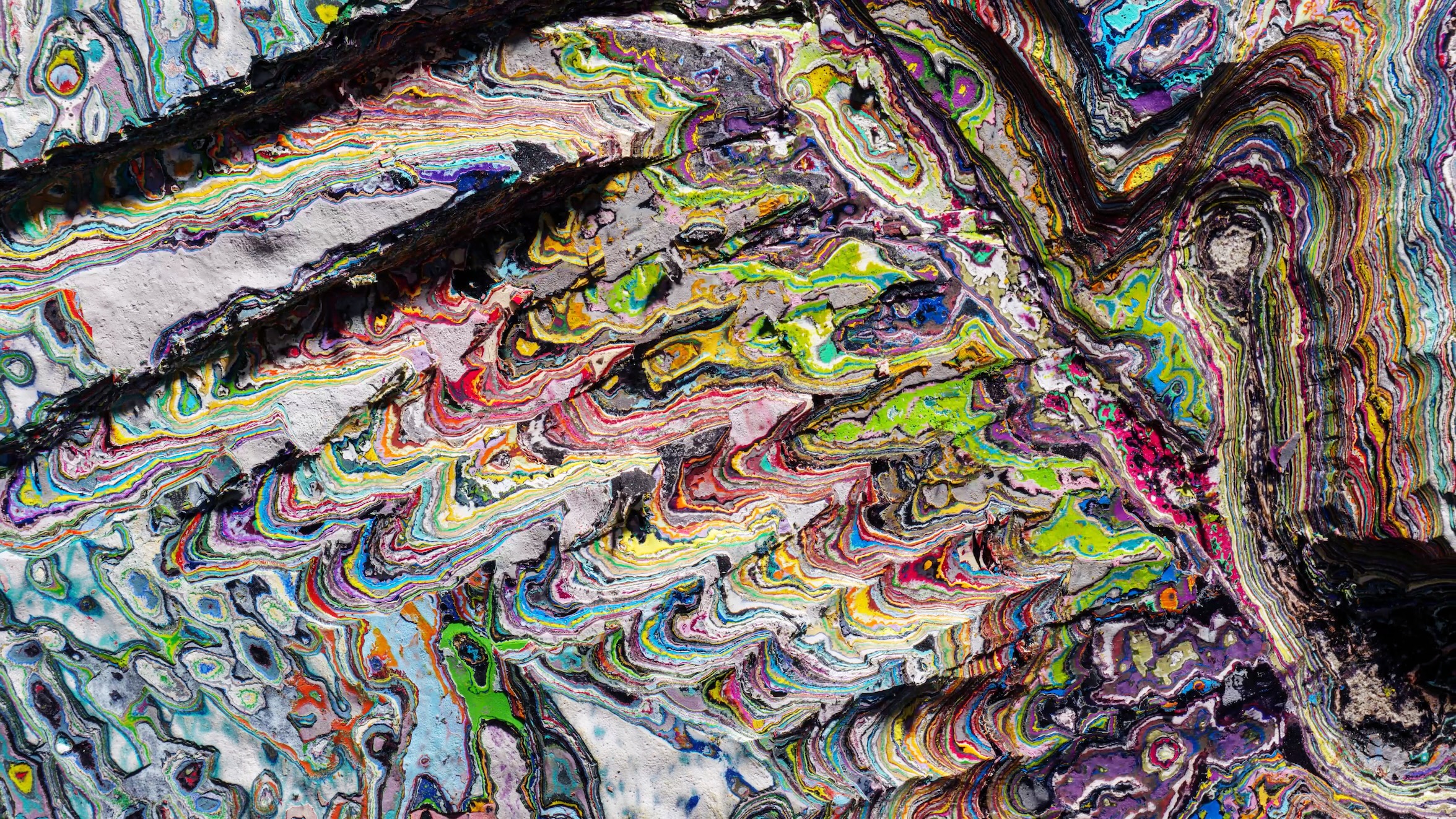
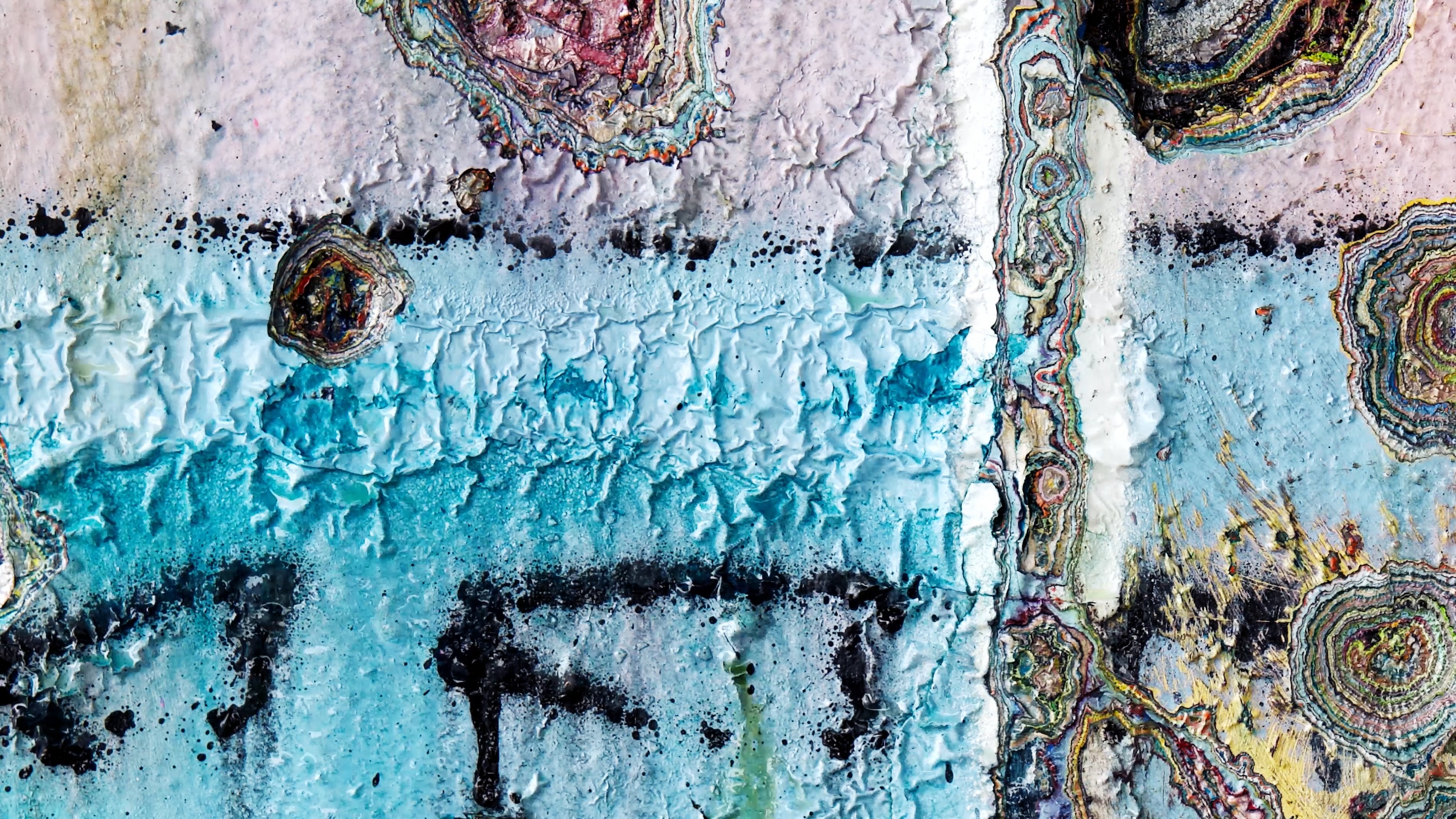
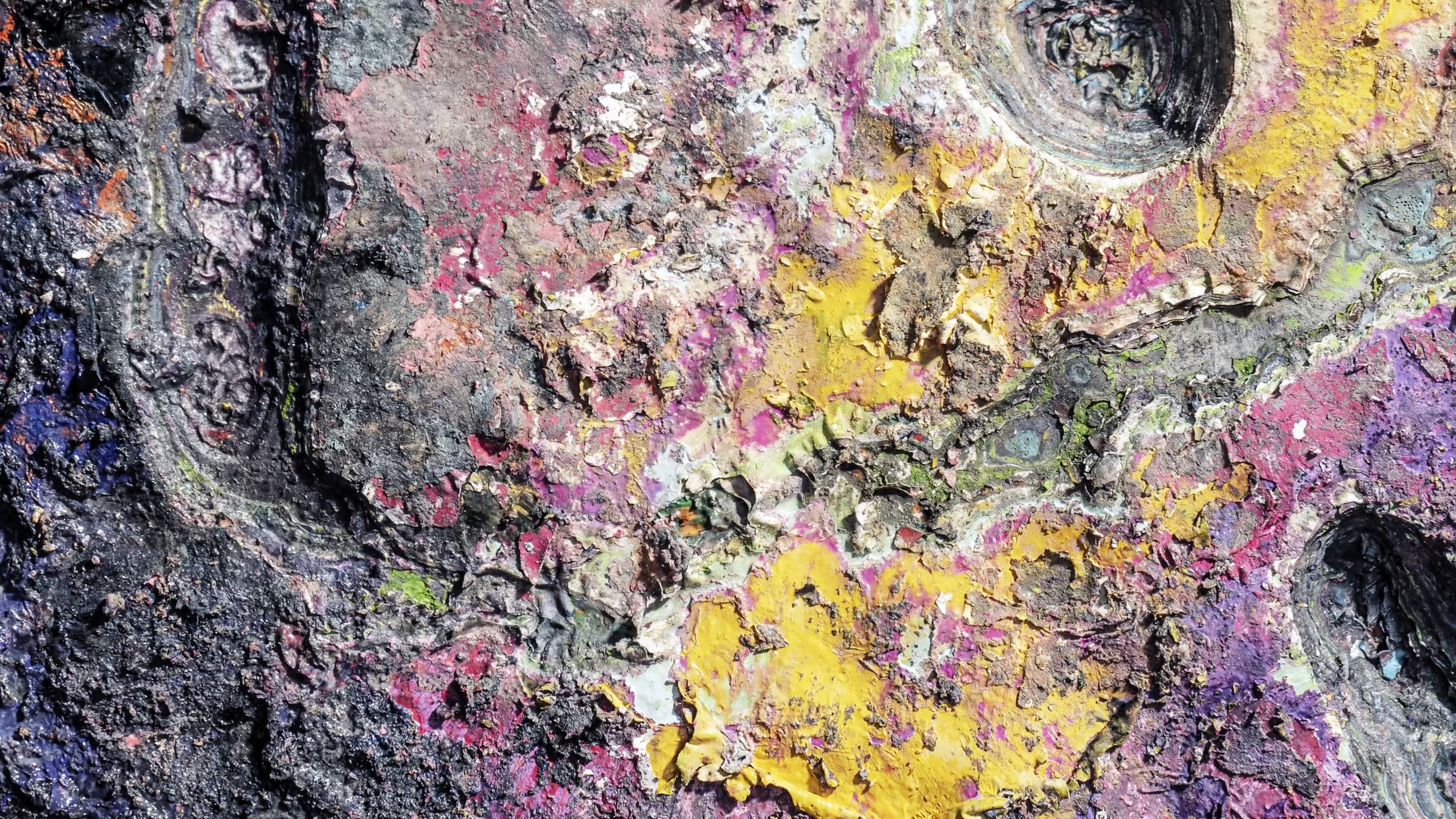
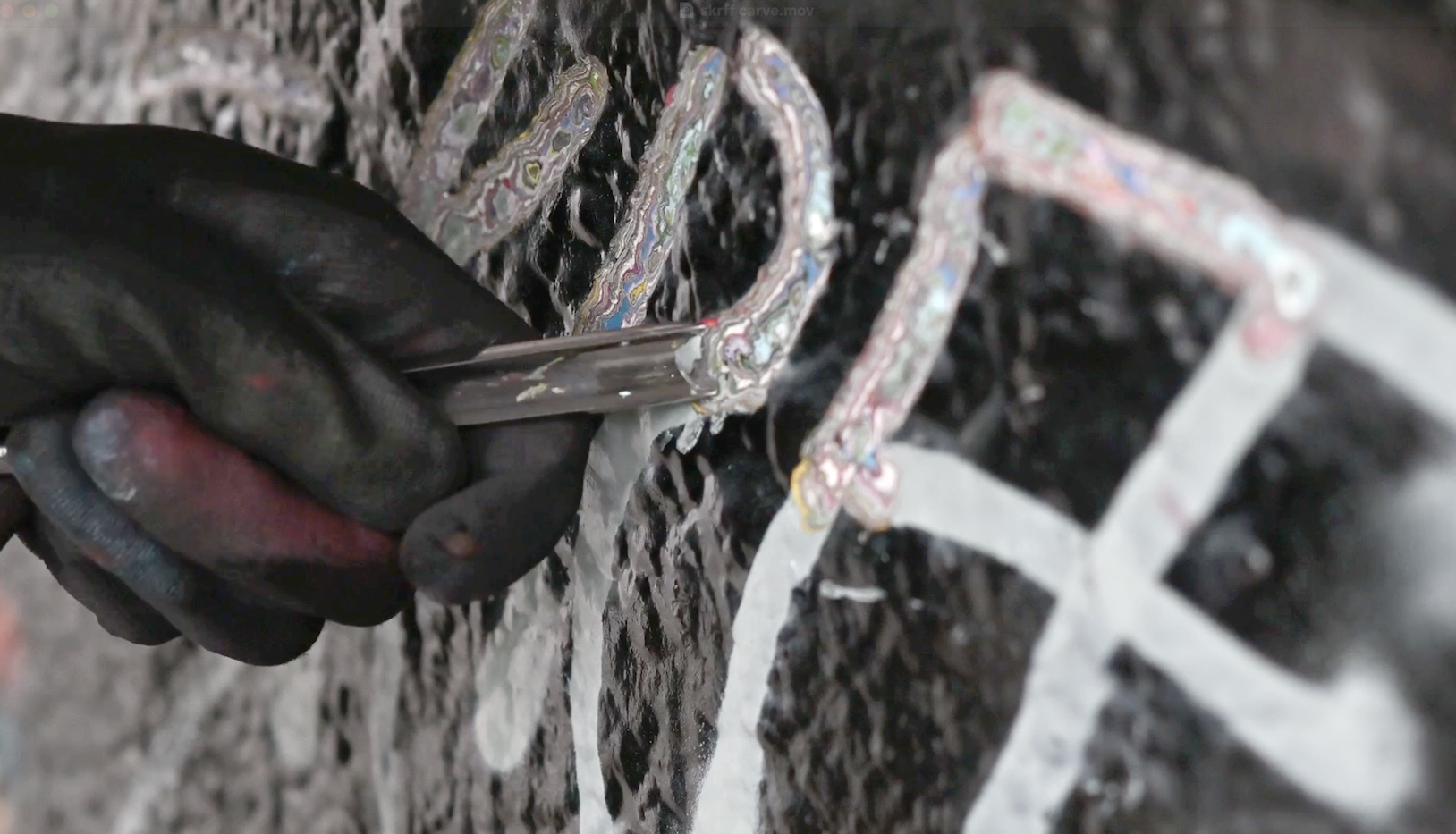
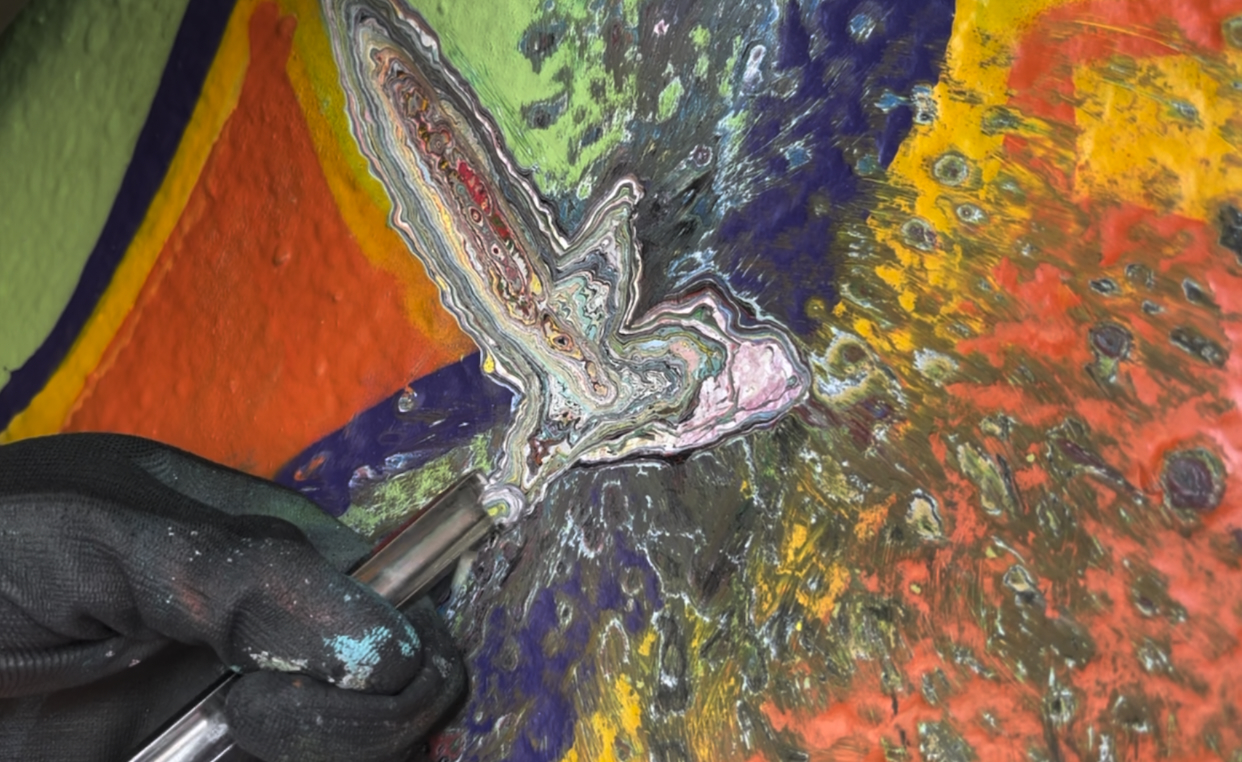
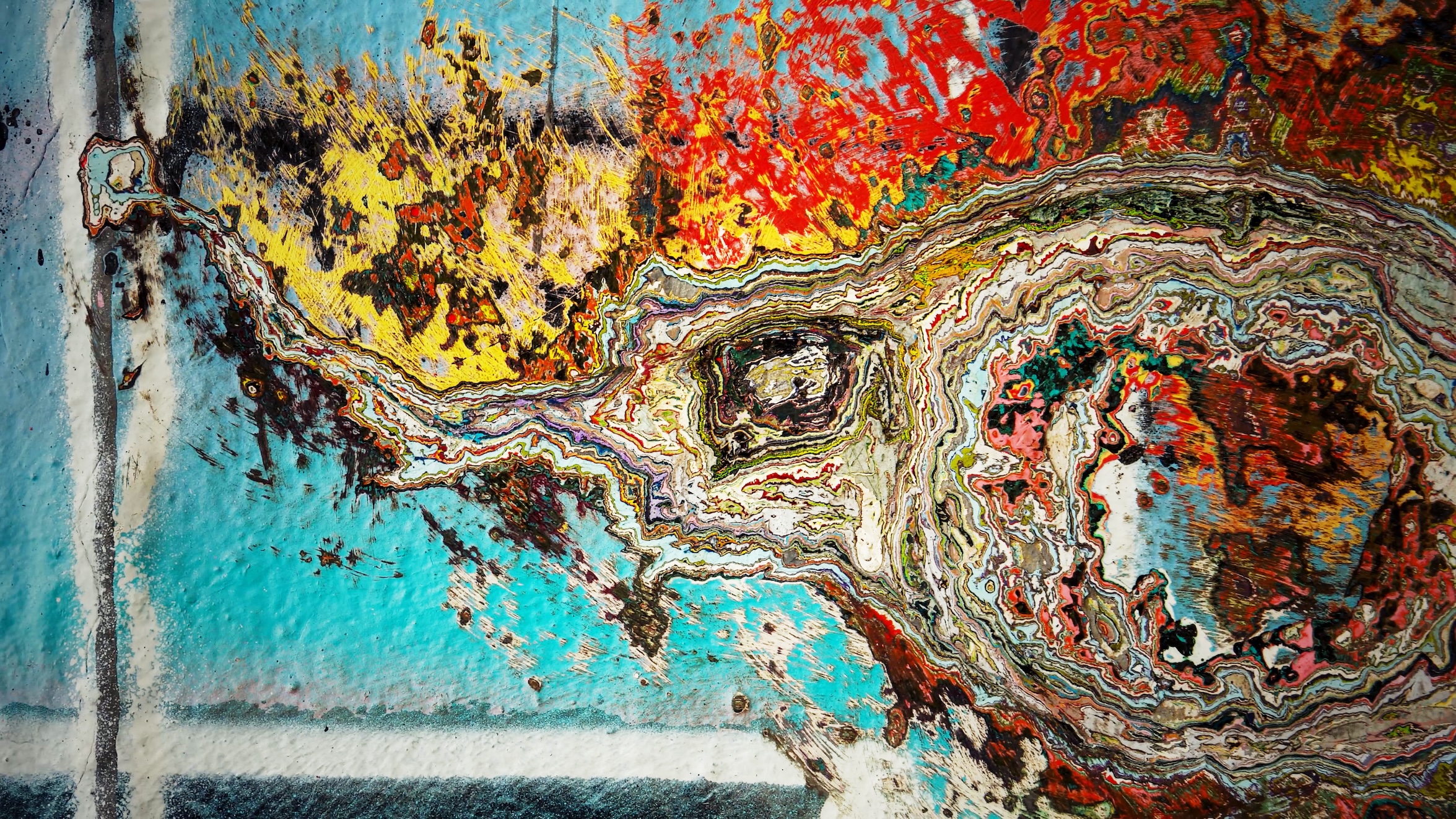
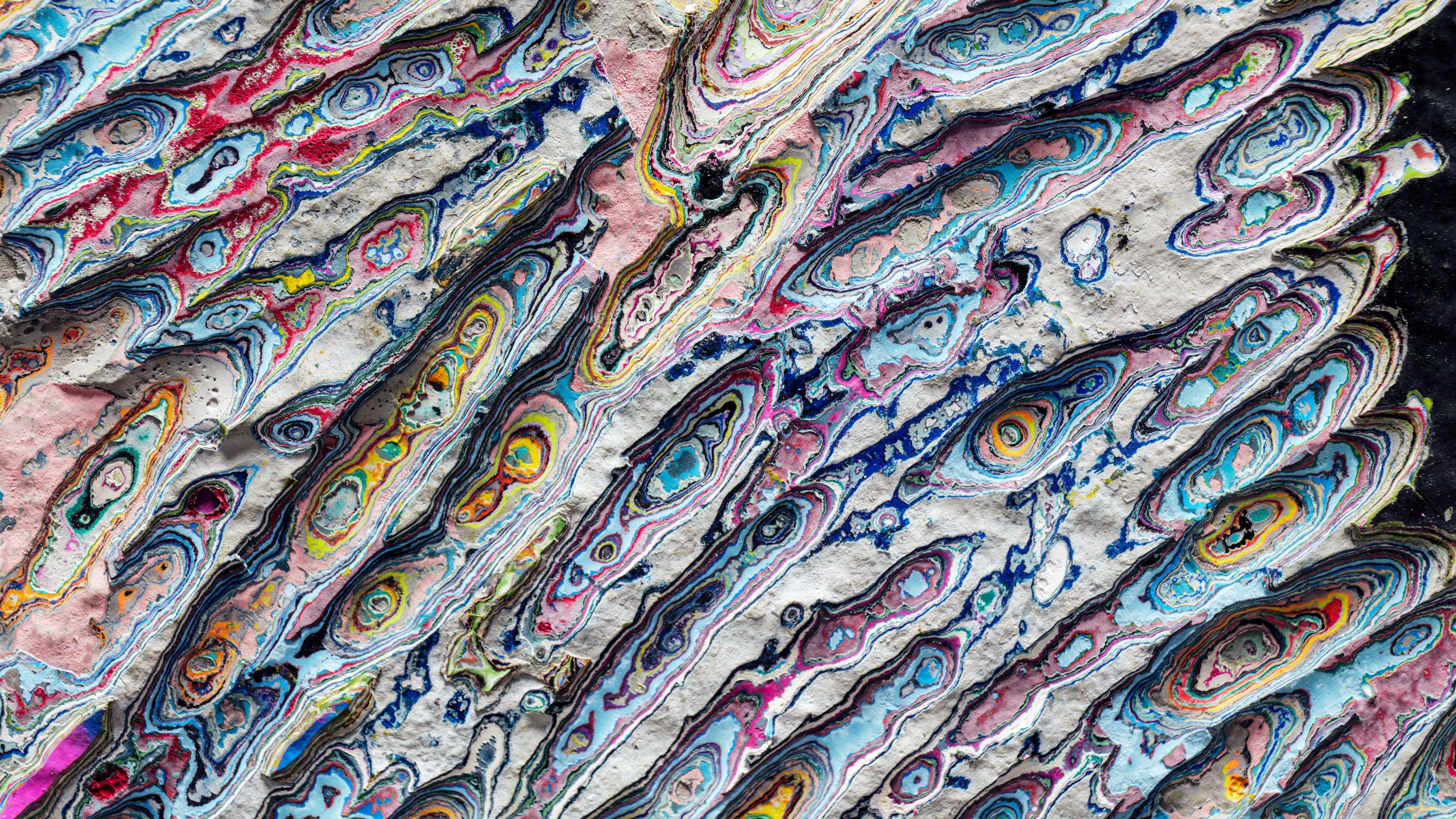
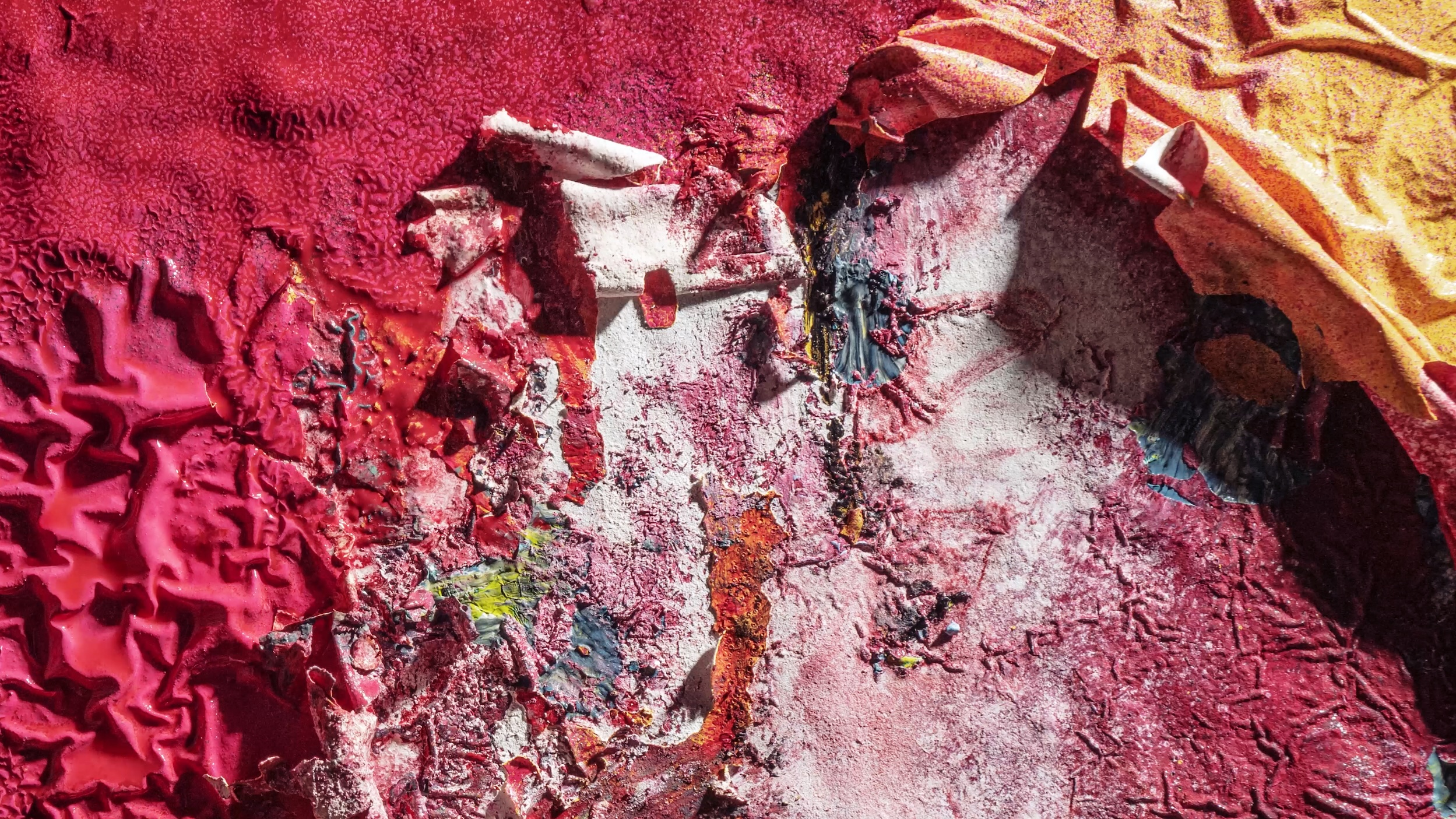
SKRFF at EVILICHTUNGEN is projected video work that activates a 40-year old graffiti wall in Vienna, Austria. We made small carvings into the paint on the wall, which is over 2cm thick, revealing the hundreds of colorful layers and bringing them to life through stop-motion animation. Each layer of color represents an entire artwork that existed in the past, but we now can only see in a limited abstract way in the present. The combination of stop-motion animation with visceral sounds compresses decades of artistic, political, and cultural expression into a new audio-visual dimension. Driven by frustration with the global rise of toxic ideologies, the artists created this street art metaphor in an earnest attempt to know and understand the past and the present.
We are really pleased to present a new version of SKRFF specifically adapted for the underpass location at Evilichtungen, which was chosen due to the urban ambience and the graffiti wall nearby. Street art is a form of expression that transcends countries and cultures and this location resonated with us and enhances the underlying themes of the work.
//How did you come up with the idea and then realise it?
Daniel: I was doing graffiti with some friends out of pure joy and the pleasure of experimentation and at one point I wondered, what would it look like to carve into the wall as I am a sculptor, working with wood as well. The question about the history of things, especially the history of Austria during WWII was very present at that time due to unsettling political changes in Austria. Therefore I started to work with it further, taking prints of the cuts, dissolving the layers of paint with acetone and so on. And I invited Corrie to join a graffiti session where she proposed to make an animated film out of the idea.
Corrie: While I was in Vienna, Daniel invited me to join some friends at one of the local graffiti walls and when he showed me the explosion of colors hidden beneath the wall, my first thought was that I wanted to see it move (an animator always wants things to move!). We did some tests over the next few weeks and they turned out incredible, so we decided to shoot as much animation as we could in the short time we had and see where it would take us.
My work manipulates time and explores the limited perspective humans have as they view the complex world. Our countries were experiencing very similar political trends and that made this project an appealing metaphor. Not to mention an exciting new animation technique to explore!
Thom: I came to Vienna slightly after Corrie and Daniel had made the first stop motion tests of carving into the graffiti walls but before we had decided to make a film. The tests were successful enough that we decided it was worth further exploration. It was really exciting testing different techniques and seeing what would work and what wouldn’t. It was very important for me that the work stayed grounded in the reality of the walls we were working on. Each layer of color was made by an actual artist and represented whatever it was that was going on at that time. It felt like bringing the viewer back to that reality was very important, this can be seen in the work alternating tight macro shots and wider shots that include more of the wall.
Sandro: When they initially asked me if I wanted to send some music for the film I did not hesitate to say yes, even though I did not know which direction it would go. There was not a single animated frame by that time, we met at the wall when they were still carving and shooting pictures. I first sent Corrie some unfinished sketches I had lying around and we started ping-ponging sound and picture back and forth, working on syncing issues and exchanging ideas for certain scenes and moods. It was great to join the project so early in the process. That way it was possible that the sound design takes on a leading role in the development of some parts, which is way more rewarding than composing sound on an almost finished piece of film.
// Is it a project that you are continuing or is it finished for you?
The short film SKRFF is a finished work that has played in film festivals for the last year. In fact, we are premiering it online very soon so it will be accessible for everyone. But skrffology can certainly take other forms and be practiced in other locations, like it has here in Hildesheim.
// What were the biggest challenges you faced while creating this work?
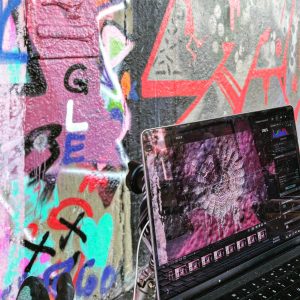
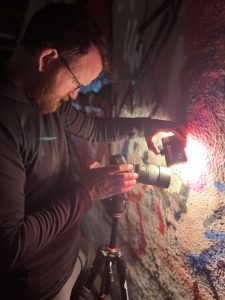
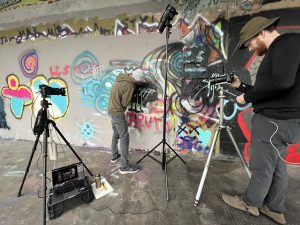
Creating animation outside is always a challenge. The light is always shifting and so at first our footage was very flickery. We tried some exposure stabilization tricks used by Timelapse photographers, but what really solved it was bringing a portable strobe to the site so we could get a consistent exposure every frame. The graffiti wall was in a public, urban setting – it smelled bad, was very dirty, with the U-bahn right behind the wall. There were lots of people walking by, some of them very curious when they saw our equipment, so we got to have some interesting conversations as we worked!
Carving into the wall was also very physical work! It’s very fast to do the first couple of frames of a sequence when the carving is still small, but with time the carvings get bigger and so it takes much more time to carve each frame – only because of the size of it. At one point we needed around 25 minutes for one frame which made us work long hours. Also it’s a very delicate process. A “big” carving is around 30 – 40 cm in diameter but the material is special and you have to work very precisely to cut exactly what you want – without knowing what we wanted of course! The carving was a very intuitive and experimental thing.
// And for EVILiCHTUNGEN 2026 ?
Adapting the film specifically for the location at Evi Lichtung was also something we were very intentional about. We were experimenting with the videomaterial when we met in Zagreb as the location at Evilichtungen is very particular and has an extreme panoramic projection format which was unsuitable for the original format of SKRFF. So we came up with the idea to do two screens side by side that are interacting with each other. Luckily we had the possibility to do live testing at Hildesheim for one night in November, that made it clear to us which of the formats work best.
The projection situation at Evilichtungen also had Sandro thinking about how to drench the audience in the rather dense sound design without overwhelming them. Drenching the audience in the reflection of the sound blasting from a combination of four subwoofers and four full-range monitors will be a challenge on-spot, but comes with the great possibility to create a site-specific iteration of SKRFF.
// What do you find particularly exciting/interesting about your work?
Sandro: The combination of the picture and the sound is very organic and one would not work without the respective counterpart. For me it was interesting and challenging to capture the sounds of the carving motion and translate it into a musical composition. I think one can feel the organic, analog origin of most of the sounds – even though I manipulated them heavily during the process. Seven minutes is also a relatively short timespan, so you can watch the film a couple of times in a row to discover new layers and details in both the picture and the sound.
The novelty of it, the experimental character. There has never been an animated film with this technique and that is interesting for people to see and try to figure out what it is they are seeing. Some do actually figure it out very quickly while for others it takes some time. And despite its background and meaning it is visually interesting and colorful. Plus it was a nice experience to actually make the material on the walls in Vienna.
// You call yourselves ‘skrffologists’, what characterises this for you?
While we were carving and having fun at the wall, we tried to come up with a name for what we were doing. As far as we understood, it was a new form of street art. It felt like a form of urban archaeology, like we were trying to discover something about the past by digging through the layers. Then the Italian word sgraffito came to mind, which means to carve into pottery or painting, but it’s also where the word graffiti comes from. So we sort of made a tag for our work, SKRFF and called ourselves skrffologists.
Sonically, this technique is reflected in the 50+ layers of tracks that form the final sound design. Some of the tracks are subtle and function as mere elements of synchronicity. Other layers take up more space. Recordings of the actual tools carving and scratching at a wall also play a crucial role in what can be heard during SKRFF.
// Do you always use the same wall as an excavation site ?
We worked at two different public graffiti wall in Vienna where it is legal to make street art. We chose walls that were mainly used for “practice” so we wouldn’t destroy anyone’s well composed artwork by carving in and tried to respect the wall and artists by working on the side and keeping our carvings small. The particular walls we worked on had been designated for public artistic expression in 1982 so we knew there would be lots of paint layers (about 2 cms!). Later, Daniel was able to find the group of artists that made the very first paintings on the wall and they gave us pictures, so that made the spot even more meaningful.
// Have you thought about other excavation sites apart from graffiti walls?
We have been interested in carving into other graffiti walls in other cities – this is why we included a small carving at the site here in Hildesheim. We thought it would be really cool to reveal the layers of past artworks adjacent to the projection. We have seen some artists who do similar works cutting through layers of advertising posters in public spaces or layers of paint on canvas, but so far we don’t have any new projects along those lines.
// Does your work respond to current social issues or tensions? Graffiti is often linked to subcultures and to the pressures of gentrification, how do these themes resonate with your project?
One of the main ideas that brought this work to life was a critique of the political situation worldwide today – with our focus being in Austria and the US of course. This work is not a statement about gentrification but the subculture of sprayers is definitely a focus. The area in Vienna where the two walls are, is one of the few very colourful and artistically free areas of Vienna due to the huge amount of graffiti there and because of its freedom there are more and more graffiti appearing. There are graffiti about political topics, personal and emotional statements, tags, decorative pieces, they all make the material for our film even though the message is not visible anymore.
// How does the context of the exhibition influence your artistic work?
The new way of displaying the film and playing back the audio made us think about how to adapt the piece for the new location. The viewers will be standing right next to an active graffiti wall as they view the work and if they look closely they may find a small surprise on the wall itself. Luckily, Evilichtungen had the means and trust in us to provide us with technical resources which allow us to experiment with many new ideas ranging from detailed easter eggs to a powerful translation of sound.
The way we plan to make the sound slap back to the audience as a reflection off the wall might introduce new problems in syncing and ask for a more dynamic sound design overall. There will be some overnight rendering on-site involved for sure, haha.
// Is something particularly important to you when exhibiting your work (especially in public space)?
The context of the exhibition space is very important of course. We were once approached to screen SKRFF in a museum with a problematic political history and we declined. At Hildesheim on the other hand SKRFF is presented in a context that fits the work very well, the urban environment, the bridge, the cars, it’s very rough. It’s pretty far from a white cube gallery and that makes it an interesting space for us to work with.
// How did you come to Hildesheim?
When we were exhibiting SKRFF at the 2024 Water Light Festival in Brixen, Italy, we met curators Klaus and Lena. They were intrigued by SKRFF and were already thinking 2 years ahead for EviLichtungen! They had this particular location in mind that would be a perfect match for the work.
// What do you know about EVILICHTUNGEN?
Because we have been involved in other light art events with this network of artists and curators, we know that the quality and integrity of the works at Evilichtungen will be top notch! There is always a good connection between the artists and the public, making contemporary art accessible and inviting, while bringing the ideas, concepts and contexts of the works into the spotlight.
// Do you have anything you definitely are looking forward to?
We are just really looking forward to being present at the festival and experiencing the atmosphere and artwork!
// What are you looking forward to at EVILICHTUNGEN?
Definitely meeting other artists, seeing some inspiring artwork and sharing SKRFF with the audience. Feel free to approach us if you run into us.