Interview with Amanda Parer while preparing for EVI LICHTUNGEN in Hildesheim 22–25 JAN 2026.
INTERVIEW BY Karoline Ketelhake
PUBLISHED 24 JAN 2026
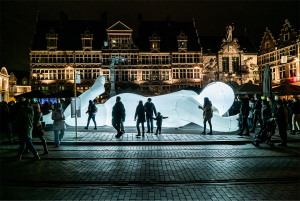
Amanda Parer is an internationally renowned artist. For EVI LICHTUNGEN, I had the opportunity to conduct an interview with her, where I asked about her way of working, her projects, and even sought her advice for artists at the beginning of their careers. Her inflatable light sculptures like “Intrude” and “Fantastic Planet” have gained significant popularity in recent years, which made me curious about how she manages so many exhibitions around the world and what lies ahead for her. With her background in multiple artistic techniques such as painting, as well as having completed studies in art management, another point of interest for me was her understanding of art and the role of light art within it. She has already been part of numerous exhibitions in Germany, but this marks her first time exhibiting in Hildesheim.
// It’s your first time at the EVI LICHTUNGEN this year. Which other artworks are you looking forward to seeing?
All of the artworks on display for this event look incredible and I credit the organisers for putting them all together to achieve a diversity of experiences and creativity for the attendees to explore and enjoy.
// It looks like you are very busy with exhibitions all around the world. How do you find the time for research and experimentation on new works? Is there something specific you are interested in at the moment?
Yes it certainly is a juggling act. I certainly count myself lucky to have the good fortune of being busy, sometimes I have to make a very conscious effort to set aside time to make new work.
I am currently working on a new experimental installation inspired by bioluminescence in nature
//How do you find all these opportunities?
Gratefully, I am mostly approached directly by art event organisers; however, I also actively apply to open calls for artists. Sometimes my work fits an event perfectly and other times it does not. I try and design my work so it can be displayed in a wide range of locations and environments.
// At first, you were mainly exhibiting in Australia. In 2015, your works were shown all over the world. What changed?
My first installation artwork was displayed in Sydney, in 2014, after this I thought that I would return to my studio and continue to create paintings. But I kept on getting requests to show my work from around the world. To me, it shows a thirst by public to engage in experiential artwork and not necessarily inside a gallery. I enjoy the egalitarian nature of public art.
// Are there multiple exhibition copies of Fantastic Planet? How long is the life cycle of an object? Are the works exhibited multiple times or recycled after each exhibition?
The artworks do indeed exist in multiple editions, stored in my three production houses in Europe, US and Australia, used for display in each of these regions. After each exhibition, the artworks are cleaned and maintained to ensure they last as long as possible. But, ultimately, the material does have a shelf life so we recycle the artworks by offering the material to other creatives and community groups to reuse and we ourselves use the material to make bags.
// At the moment, how big is your team to realise and manage all these exhibitions? How do you keep an overview, and do you travel to every exhibition
Our team is small but highly focused. We share updates within the team on the preparation of exhibitions happening simultaneously around the world, and regularly review the progress of each project to ensure that communication with clients is thorough and nothing is overlooked.
While it would be ideal to attend every exhibition, I participate in events where the schedule allows. Travelling from Australia and experiencing new landscapes, perspectives, and cultures serves as a key source of inspiration for me.
// What is your understanding of art, and what kind of role does light art play within it
I love art because it acts as a snapshot in time. Art is a response to issues of the day. I love that the art changes depending on who is making it. It is another way for our experiences and stories to be reflected back to us. I love that it is so versatile; it can be serious, humorous, miniscule, enormous, it can be surface level in meaning or warrant a Phd to understand. In a way has the ability to portray the length of breadth of our expressions and experience as humans.
// Why did you decide to work with light as a medium?
I live in Tasmania, Australia’s smallest and most southern state. It is situated deep under the globe, along the roaring (latitude) 40s which means the weather can get very dramatic. Much of the environment is still pristine and light is a character of the landscape, this has influenced my work. I also like the metaphoric symbolism light offers, especially contrasting it with darkness.
// Last but not least, do you have any tips or advice for early-career artists?
Find your voice (both visually and conceptually), find your niche in the field, have a thick skin (you’ll face a lot of rejection) and hang in there. It’s the stayers that last.
It’s an honour to have a career that allows for creativity expression, so have fun!
LINKS
amandaparer.com
@amandaparer
FEATURED IMAGE
Amanda Parer. Klanglicht. Photo: Amanda Parer Kanizaj